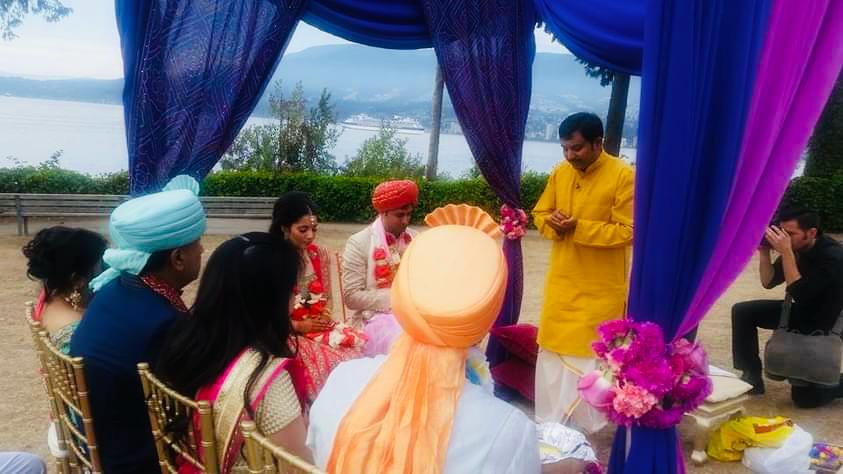
The Philosophy of the Hindu Wedding
The Cosmic Choreography of Love: A Masterclass on the Vedic Wedding
Welcome to the Insights page. Over my decades of officiating ceremonies, especially here in Southern California, one of the most profound inquiries I receive from our US-born youth is regarding the traditional Hindu wedding. To the untrained eye, it can seem like a beautiful but chaotic amalgamation of colors, chants, and fire.
However, the Vedic wedding ceremony, or Vivaha-Samskara, is widely regarded as the most intricate and spiritually significant of the sixteen sacraments in the Hindu tradition. In the modern era, the necessity to balance these profound ancient traditions with contemporary scheduling constraints has led to the development of a streamlined liturgical framework.
As your priest and guide, I want to break down the philosophy and meaning behind this ancient sequence for you. Let us treat this as a psychological and spiritual masterclass in partnership.
The Philosophy of the Union
"The term Vivaha is derived from the Sanskrit roots vi (special) and vaha (carrying), signifying the special responsibility each partner takes to support and carry the other through the journey of life."
Phase I & II: Aligning the Cosmos and the Ancestors
The ceremony does not begin with the couple; it begins with the universe. The few minutes of the ceremony are dedicated to establishing a sacred environment. The Mandapam, or the four-pillared pavilion, is a symbolic representation of the universe, and its sanctification is necessary to ensure the ritual is performed in a space free from negative vibrations.
Before joining two people, we align the nine celestial bodies (Navagraha) to harness the beneficial energies of the planets for a stable married life. We also honor the ancestors (Pitris), as the liturgy insists that ten generations before and ten generations after are impacted by the merit of a properly performed Vivaha.
Phase III: The Empress and the Gift (Kanyadaan)
One of the most misunderstood concepts for US-born generations is the Kanyadaan. It is often misunderstood as the "giving away" of a daughter as property, but liturgically it is the most sacred of all gifts. The father declares that he is entrusting his daughter—who represents his ultimate wealth and merit—to the groom for the purpose of fulfilling Dharma, Artha, and Kama.
Furthermore, any notion of patriarchal subordination is dismantled during the Kanya Puja, where the groom's parents welcome the bride as Goddess Lakshmi. The Vedic tradition dictates that she be welcomed as the Samrajni (Empress) of the household.
Phase IV: The Fire Witness and the Ego Check
The fourth phase is the spiritual core of the wedding, centered on the Agni-Vedi (fire pit), as fire is the only witness that can bridge the physical and spiritual realms.
As offerings are made into the fire, we chant the mantra Idam na mama (This is not mine), which serves as a psychological training in selflessness. The repeated offering of ghee and grain into the fire with these words is a ritualized practice of non-attachment, serving as a constant "ego-check". A marriage frequently fails when partners prioritize their own needs or pride over the health of the union.
During this phase, we also perform the Laja Homa, where the bride's brother places puffed rice into her cupped hands. The rice represents prosperity and fertility, while the presence of the brother symbolizes the continued support of the bride's original family.
Phase V: The Four Circles and the Seven Steps
The physical journey of the marriage is mapped out through the fire. The couple circles the fire clockwise, tied together by a knot. Each circle represents an aspiration: Dharma (piety), Artha (wealth), Kama (desire), and Moksha (liberation). During these circles, the bride steps on a grinding stone (Shila), symbolizing her resolve to be as firm as a rock in the face of life's adversities.
Then comes the Saptapadi (seven steps), the rite that makes the marriage final and irrevocable. With each step, they invoke Lord Vishnu for nourishment, strength, wealth, harmony, healthy progeny, shared responsibilities, and everlasting friendship. After the seventh step, the groom tells the bride: "By these seven steps, you have become my best friend".
The Final Integration: The Equal Half
Following the vows, the couple performs the Asan Parivartan (Seat Exchange), where the bride moves to the groom's left. This transition signifies her new position as his equal half (Ardhangini), sharing in all his life's duties and spiritual journey. Finally, the groom gently applies Sindoor (red vermillion) into the parting of the bride's hair, symbolizing her status as a married woman and a visual representation of his lifelong promise to protect her.
In the diaspora context, my role transitions from a mere ritualist to an educator. Knowledge is the highest form of sacrifice, and when the couple understands their vows, the ritual transition is more profound and lasting. By following this comprehensive manual, we ensure that the ancient wisdom of the Vedas remains a living, breathing, and potent force in the lives of the modern couple.
Pandit Manuj Dutt
Offciant, Hindu Priest & Vedic Astrologer
#VedicWedding #HinduWedding #Vivaha #Saptapadi #SevenSteps #IndianWeddingUSA #PanditManujDutt #PowerPujaUSA #HinduPriestCalifornia #WeddingRituals #DesiWedding #SanatanaDharma #CosmicLove #VedicAstrology #ModernCouples
Ready to plan your own beautiful wedding ceremony?
Explore Our Wedding Services